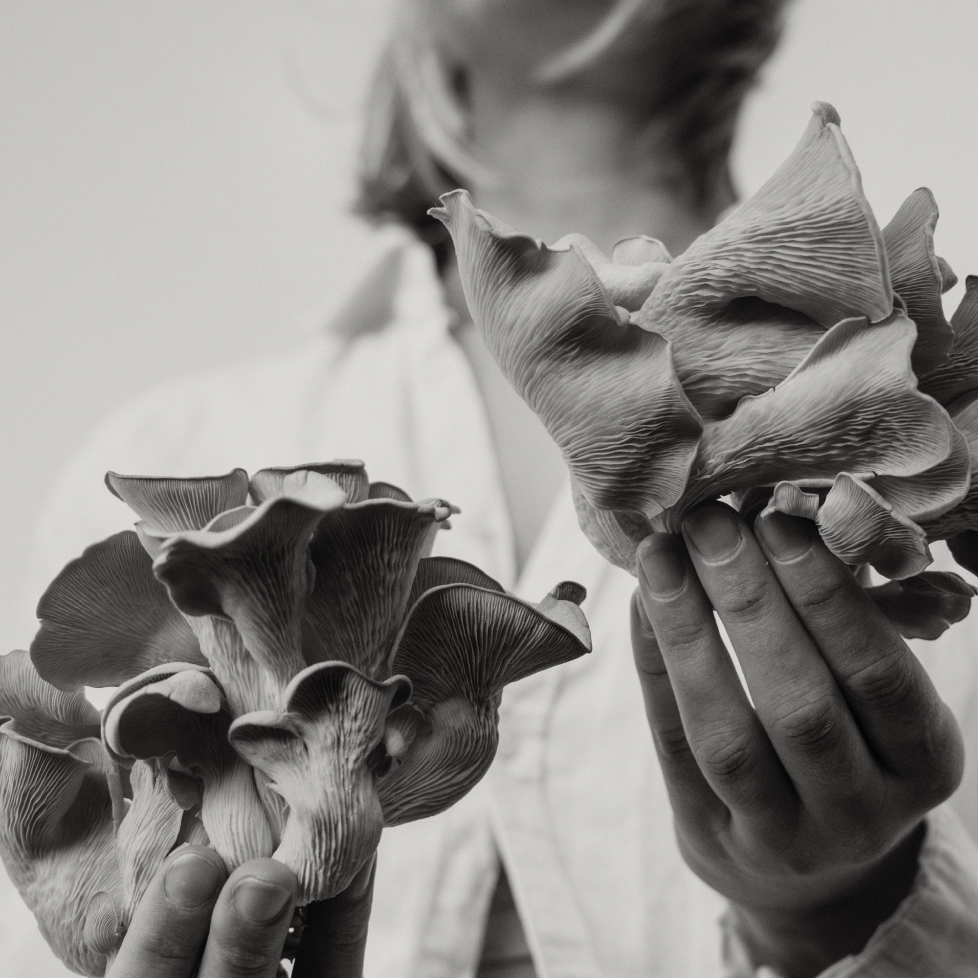
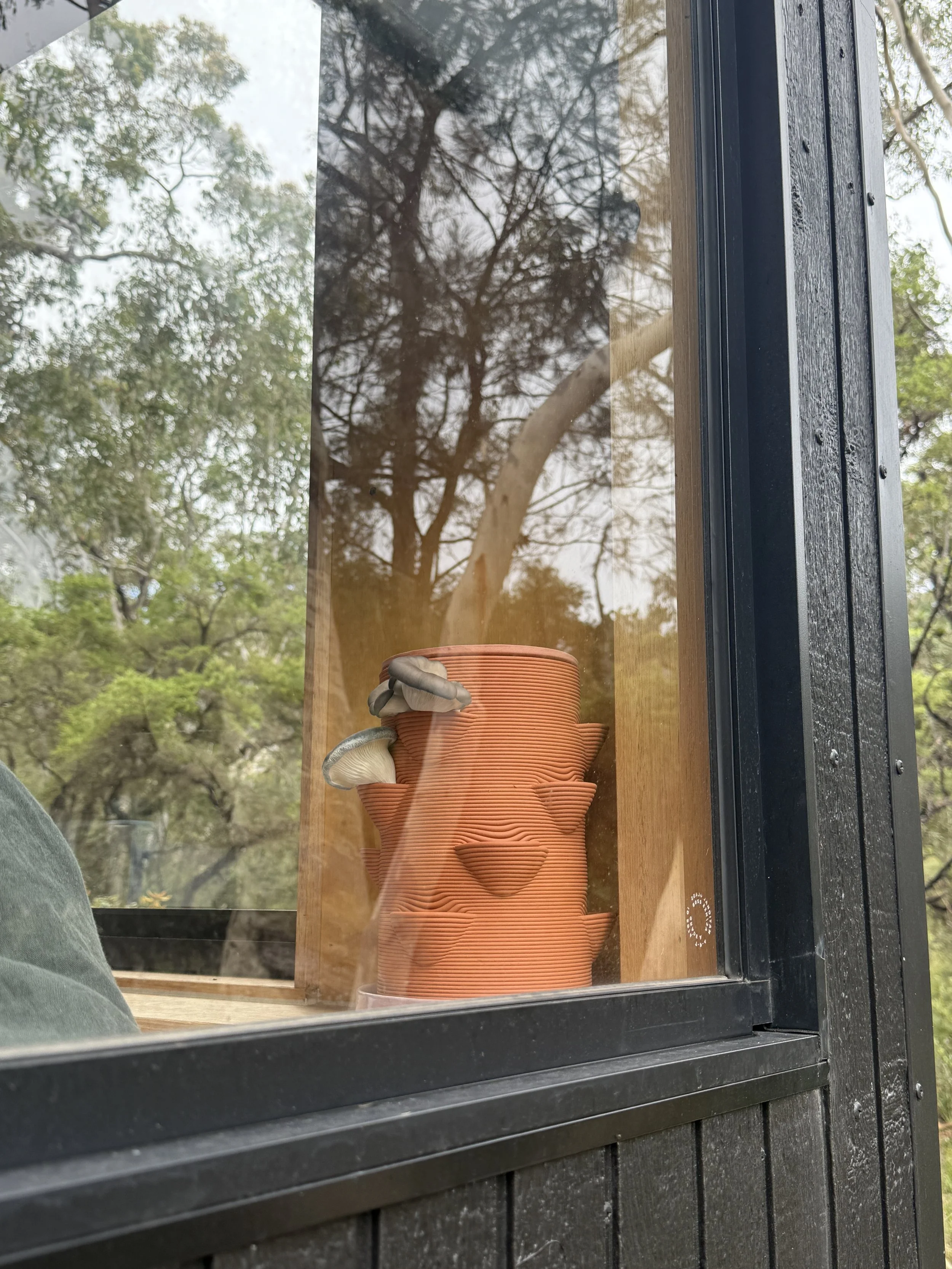
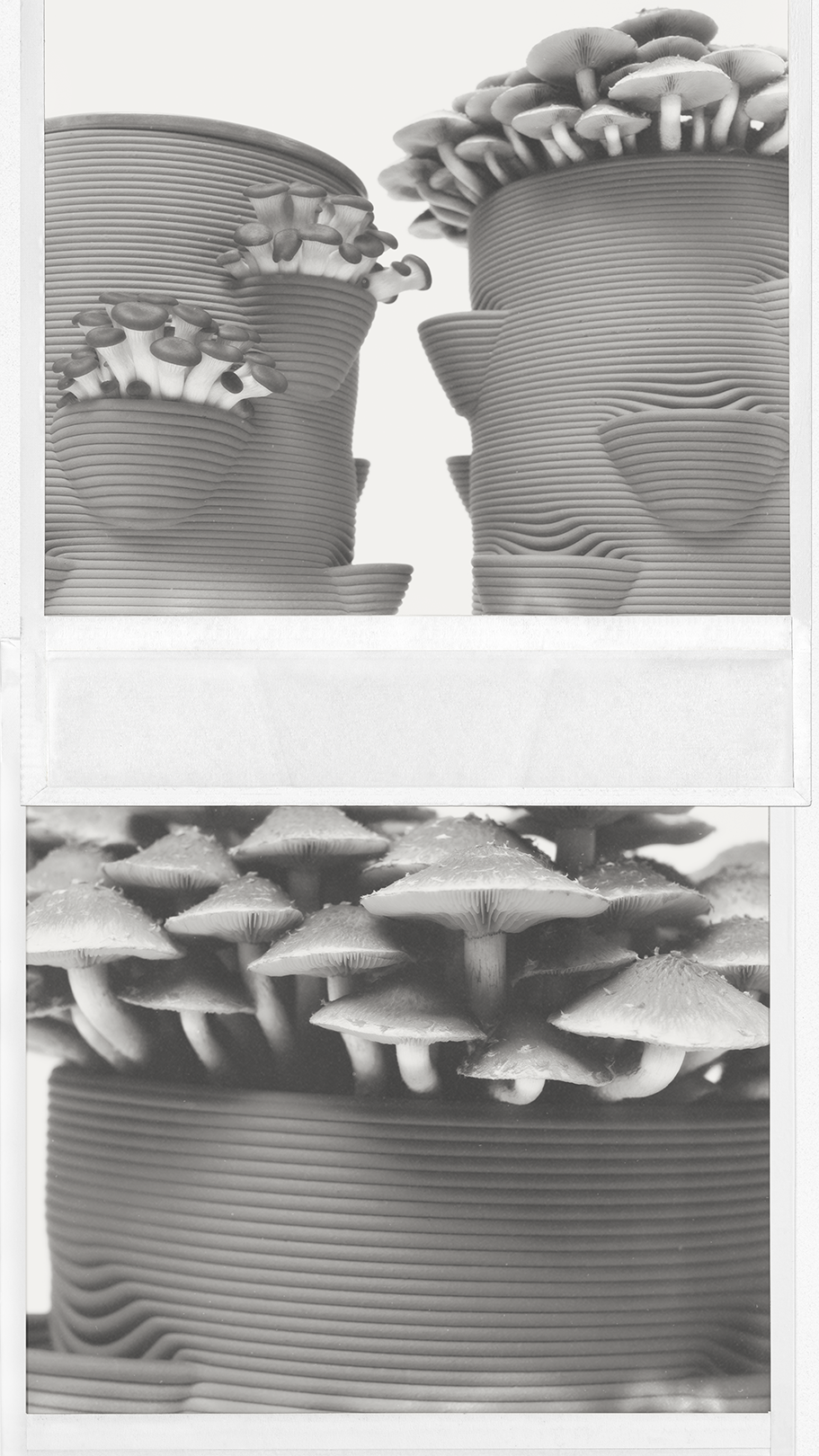
Mycelia House is a cultivation system for growing and showcasing the beauty of oyster mushrooms in the home.
The design promotes a move towards more sustainable and localised food practices, an appreciation of the fungi kingdom, and a deeper connection with nature.
Mycelia House exists to re-centre our relationships.
Our work sits at the intersection of science, nature, and creativity - creating objects and systems that invite care and connection.
In a globalised world shaped by rapid technological change, there is a growing need for ways of living that are more harmonious. Many of us are experiencing a disconnection from ourselves, from one another, and from the natural world - a disconnection that has come at a cost.
Mycelia House offers a vessel for exploring these relationships anew. Through the simple act of growing food, tending to living systems, and listening to the elements, we can begin to cultivate greater reciprocity, presence, and care.
We envision a future that honours traditional and analogue ways of living, while allowing technology and cities to evolve and change. It is a practice of remembering - carrying forward ancestral knowledge and applying it thoughtfully within the world as it is today.
As a brand, Mycelia House exists as an open space for exploration - a meeting place where ideas, practices, and communities can grow, both individually and collectively.
Inaugral design:
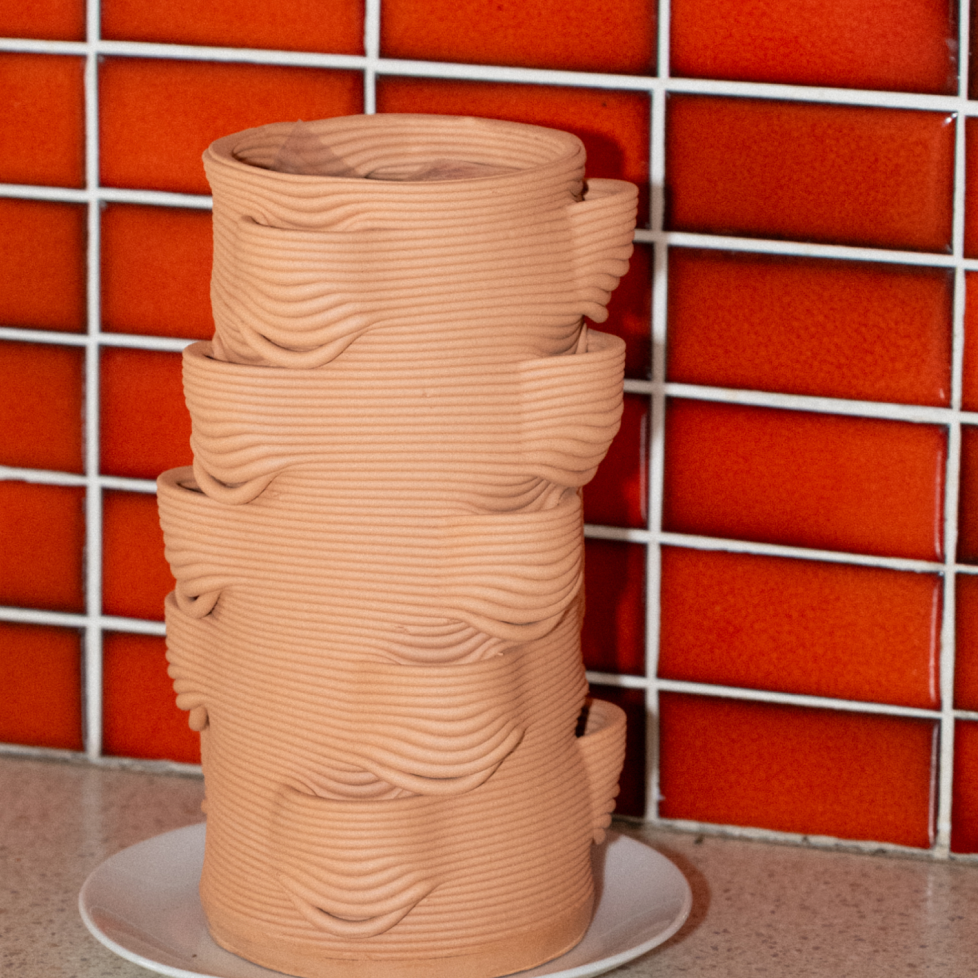
Mycelia House, teracotta cultivation system
Mycelia House is a home cultivation system for growing oyster mushrooms. It’s inspired by DIY bucket grows and cardboard spray-and-grow kits.
It’s reimagined as a considered, sculptural object in the home - lending dignity to the mushrooms. Mycelia House is designed for oyster mushroom varieties that side fruit, with top-fruiting varieties coming soon.
Mushroom grow kits offer an accessible and engaging way for beginners to cultivate their own mushrooms at home, while also gaining insights into a more circular food system.
The terracotta design leverages its natural wicking properties to create an ideal microclimate for mushrooms to thrive. Simply add water to the tray and lightly mist around the vessel twice daily. Mushrooms typically begin fruiting within 5–7 days.
Each Mycelia House includes a grow guide booklet to support you on your cultivation journey. Please note: mushroom growth substrate is sold separately.
The design philosophy
Mycelia House emerged as a response to what feels most needed now: a call to re-centre our relationships - to listen more deeply, care more fully, and rebuild inner and outer threads of connection.
At its core, Mycelia House is about imbuing ritual into everyday life through care and attention.
By tending to the mushrooms each day, the design encourages presence, patience, and responsibility. The intention is not only to grow food at home, but to imagine a future where food is grown locally, shared within communities, and embedded into daily rhythms.
Mycelia House envisions a shift toward sustainable and regenerative food systems that prioritise quality, efficiency, and wellbeing - that are built in reciprocity.
Design context
The blends industrial design, craft, science, biology and technology, showing how contemporary objects now exist in hybrid states. It a shift towards regenerative, symbiotic frameworks in 21st century design.
What began as an exploration of mycelium as a sustainable material in design shifted into the development of a home cultivation system. Each stage of the design process allowed the design to unfold in the way it has.
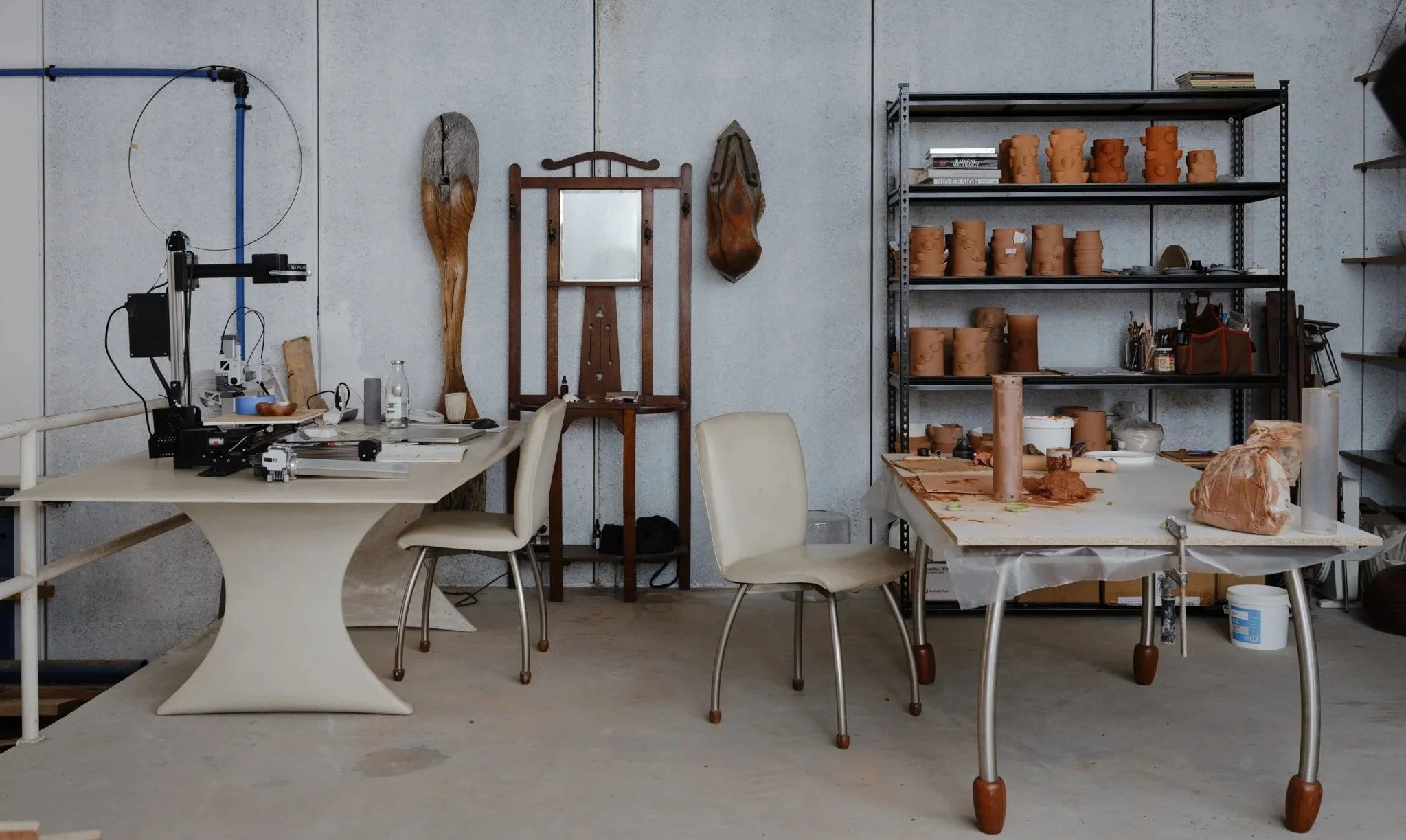
The vessel embodies a new design language, with ceramic 3D printing merging algorithmic precision with handmade variation. All museums have ceramics that tell us how societies lived, and Mycelia House shares the story of now.
Follow the hyphae [here] to learn more.
Sustainability and Making
Sustainability at Mycelia House is understood as a living practice - shaped by observation, care, and ongoing learning. At every stage of the process, from relationships and research to materials, manufacturing, use, and end of life, decisions are guided by responsiveness rather than certainty. This way of working is inspired by mycelial networks themselves: adaptive, relational, and oriented toward balance.
Imagine a world that values the beauty and reciprocity of the fungi kingdom - where systems are designed not for extraction, but for mutual support. Fungal networks show us how life thrives through cooperation, distribution, and shared resources. As Paul Stamets writes, “Through the genius of evolution, the Earth has selected fungal networks as a governing force managing ecosystems.” This intelligence offers a powerful model for how we might rethink the systems we live within.
We are living at a moment where the impacts of past decisions are visible - environmentally, socially, and economically. Globalised systems of production and consumption have prioritised speed, convenience, and scale, often at the expense of soil health, biodiversity, community resilience, and food security. Mycelia House responds to this context quietly, through practice rather than prescription, by supporting local, circular ways of growing and consuming food.
Growing food at home shifts our relationship to consumption. We tend to waste less, grow only what we need, and develop a deeper respect for the effort and resources involved. When food is grown locally, within homes and communities - it becomes less of a commodity and more of a shared responsibility.
Sustainability, in this sense, is not only about materials. It is also about how we listen, respond, and relate to the world around us. First Nations cultures have long embodied this understanding, living in deep relationship with land, water, and all beings - guided by principles of reciprocity, restraint, and care for future generations.
Mycelia House is made in small batches in Sydney, Australia, combining emerging ceramic 3D-printing technology with traditional handcrafted techniques such as slip casting. The ceramics are designed to be durable and long-lasting, supporting repair, reuse, and continued care rather than disposability.
Used mushroom substrate can be returned to the earth to enrich soil. Plastic grow bags should be disposed of in the bin, while bio-based alternatives are actively being explored and will be adopted when viable. Growers may also choose to create their own substrate and place it directly into the vessel.
Sustainability is not viewed here as a final outcome, but as an aspiration - something shaped through humility, reflection, and adaptation over time. Like mycelium, progress emerges through small connections, careful listening, and a willingness to learn from what works - and what does not.
Values and Processes
Inspired by mycellium.
-
The balance of being caring - not careful, not careless.
A process. A practice of listening, responding, tending to.
“Treat design like a gardening practice”- Neri Oxman, Biodesigner
Allowing there to be mess.
Action over perfection.
-
Intimacy. A relationship.
An evolving conversation.
Exchange of resources.
Symbiosis as living together in mutually beneficial ways.
-
Not parroting.
A process of digestion, integration, articulation and expression.
Prioritising this process so that something is embodied, not simply mental/
-
The willingness and strength to act on creative visions.
-
An openness to explore and build - to thread new connections and pathways.
Acknowledging nature’s life/death/life cycles.
A seasonal business, open to change.
-
A vision for unity.
Shared visions, working in collaboration, approaching complex issues with a multi-disciplinary lens.
The Designer and Founder, Caity Duffus
The project began as Caity’s Industrial Design Honours work in 2020 and has since grown into a small-scale commercial product rooted in craft. Follow the hyphae [here] to learn more.
The Network
Mycelia House has been shaped by a generous and growing network of collaborators, mentors, and supporters, and the intention is for this to continue expanding.
The project welcomes collaboration across disciplines - bringing creatives together to share stories, create experiences, and explore the beauty and application of fungi within our systems.
Caity received funding and mentorship support through the Carl Nielsen Accelerator Program with the Powerhouse Museum, without which Mycelia House would not be where it is today. Deep thanks to Ed Ko, Angelique Hutchison, Tashi Grey, and Adam Laws for their support, and to Ruffle Farm and Milkwood for sharing their mycological knowledge.
Standing behind every creative is a strong support network. With gratitude, Caity would like to acknowledge Robbi Pittorino, Vicki Grima, Andrew Simpson, Sabrina Piro, Jess Coulson, Joel Brauer, Nick Rita, Carolyn Hickey, Susie Hemsted, Mirna Novosel, Nicola Jephcott, Luke Reid, Glenn Duffus, and Sue Duffus.